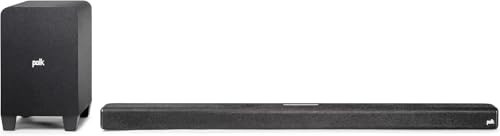
The Polk Signa S4 is a 3.1.2-channel Dolby Atmos soundbar that ships with a wireless subwoofer. It sits in the mid-range of Polk’s Signa line, above the virtual-surround Signa S2 and S3 and aimed at people who want a bigger, more cinematic sound than a basic TV bar can deliver without buying separate speakers. This profile goes through what Polk says the soundbar does, where its limits are and which kind of home it fits.
This profile rests on published sources, not on our own use of the soundbar. We compared the specifications and descriptions published by Polk and by other sources, and we say so wherever a claim comes from a single source. For how it stacks up against the rest of our lineup, see the best soundbars of 2026 comparison.
The Short Version
The Signa S4 is a complete, no-fuss package. In the box you get the bar, a wireless subwoofer, a remote, an HDMI cable and an optical cable. You plug the bar into your TV’s eARC or ARC port, power on the subwoofer and the two pair automatically. For a living room with a TV around 50 inches or larger, that simplicity is the main attraction.
The trade-offs are mostly about what is missing. There is no Wi-Fi, so no streaming services, voice assistants or multiroom features. There is a single HDMI port, so everything else in your setup has to go through the TV. And true Atmos requires eARC, which not every older TV has. If you want a smart soundbar that doubles as a music system, look at the Sonos models in our lineup instead. If you want a simple, sizable upgrade for movies and TV, the Signa S4 is a reasonable fit.
Key Specs According to Polk
These details come from Polk’s official Signa S4 product page.
- Format: 3.1.2 channels, Dolby Atmos certified. Polk says standard audio can be upmixed to a virtual Atmos experience.
- Soundbar drivers: two 1-inch tweeters, two 4.7 x 1.6-inch racetrack mid drivers, one 1-inch full-range center driver and two 2.6-inch up-firing elevation drivers.
- Subwoofer: one 5.9-inch woofer in a wireless cabinet measuring 7.9 x 12.9 x 11.0 inches.
- Soundbar size: 41.2 x 3.7 x 2.4 inches. Polk’s spec list orders these as width, depth and height, while its comparison table orders them width, height and depth, so check the manual for the exact height before you measure a shelf.
- Inputs: one HDMI eARC, one optical, one 3.5 mm analog, and Bluetooth. USB-A is for firmware updates.
- Dialogue and sound modes: VoiceAdjust, BassAdjust, and one-button Movie, Music and Night modes.
- In the box: soundbar, subwoofer, remote, two power cords, HDMI cable, optical cable, two AAA batteries, a wall mount template and wall mount spacers.
Polk’s page is inconsistent about the driver count. One section calls it a seven-driver array and another mentions eleven drivers in total. The spec list above is the most precise statement, so we use it and avoid a single headline number.
Dolby Atmos From a Single Bar
The two small up-firing drivers are what separate the Signa S4 from the cheaper Signa models. They point toward the ceiling, and the idea is that sound reflects off it so effects such as rain or helicopters seem to come from above. Polk says the soundbar supports Atmos height channels and can create a virtualized Atmos effect from non-Atmos content.
A few practical points follow from how this kind of design works. Ceiling reflection works best in a room with a flat, reasonably low ceiling, so a vaulted or very high ceiling will weaken the effect. Streaming apps and discs only deliver Atmos if the content is encoded for it and your TV passes it out over eARC. And the Atmos effect from any single bar is smaller than the real thing from rear and ceiling speakers. Treat it as a more open, taller soundstage rather than full surround.
Dialogue and Night Listening
Dialogue is one of the most common complaints about TV audio, and Polk builds two features around it. VoiceAdjust, which Polk describes as patented, works with the dedicated center channel so you can raise the level of voices while leaving the rest of the soundtrack alone. That is useful for quiet dramas, for people with mild hearing difficulties and for movies with loud scores.
Night Mode lowers the bass and increases VoiceAdjust with one button, so you can keep conversations clear without turning the master volume up. In an apartment with thin walls or a house with a sleeping child, that matters more than any surround spec. BassAdjust, according to Polk, controls bass on both the bar and the subwoofer so the two blend. In practice, that is one setting for the amount of low end, not two to juggle.
The Subwoofer
Polk describes a powerful wireless subwoofer that connects automatically on start-up and can be placed almost anywhere in the room, in front for punch or behind the couch for rumble. The woofer is 5.9 inches, which is small by home theater standards. Do not expect the chest-thumping depth of a 10- or 12-inch sub. For apartments, small living rooms and bedrooms, that is actually a benefit, because there is less risk of annoying the neighbors.
The sub needs a power outlet, so plan where it goes. It is wireless in the sense of the audio link only. The cabinet is compact enough, at roughly 8 inches wide and 13 inches deep, to slide beside a couch or next to a media console.
Connections and Compatibility
Setup is deliberately simple. Polk says the Signa S4 works with any TV through one cable: HDMI eARC or ARC, optical or the 3.5 mm aux input for older sets. Here is how that plays out in practice.
- TVs with HDMI eARC: the best case. You get Atmos from sources that carry it, and the TV remote can usually control volume.
- TVs with HDMI ARC only: you get surround sound from standard formats, but Atmos is limited, since Polk says Atmos requires eARC.
- TVs with optical only: works fine for stereo or Dolby Digital, with no Atmos.
- Fire TV, Roku, Apple TV, Samsung and LG sets: all of these send audio the same way, through the TV’s own ARC or eARC port. Plug the soundbar into the port labeled eARC or ARC and select it in the TV’s sound settings. If you have a game console or streaming stick, connect it to the TV rather than the soundbar, since the bar has no HDMI input of its own.
- PCs and monitors: a monitor with no HDMI audio return cannot use eARC. Use the optical or 3.5 mm input, or Bluetooth, and expect stereo.
One practical tip: after plugging in, check the TV’s audio output setting. Many TVs default to PCM or Dolby Digital. If you want Atmos, look for an option such as “Auto,” “Pass-through” or “Dolby Atmos,” depending on the brand.
Size and Placement
At 41.2 inches wide, the bar is wide enough to sit comfortably under a TV of about 50 inches and up. A 55-inch TV is roughly 48 inches wide, so the soundbar will look right in proportion. Under a 32- to 43-inch TV, it can look oversized, and a TV stand narrower than the bar will not hold it. Polk calls the design low-profile and says it will not block your TV or its remote sensor, though it is worth checking the height of your TV’s feet against the bar before you buy.
Polk includes a wall mount template and spacers. If you mount the bar below a wall-mounted TV, leave a few inches of gap, and keep the bar’s top surface free so the up-firing drivers can reflect sound. Do not put the bar inside a cabinet or under a shelf, since that blocks the height effect.
Pros and Cons
Pros
- True Dolby Atmos layout with up-firing drivers over eARC
- Dedicated center channel plus VoiceAdjust for clearer speech
- Wireless subwoofer included, with BassAdjust to blend it
- Night Mode for late viewing
- HDMI and optical cables in the box, with wall-mount hardware
Cons
- No Wi-Fi, apps or voice assistants, only Bluetooth
- One HDMI port with no passthrough
- Atmos needs eARC
- Large for TVs under about 50 inches
- Small subwoofer driver compared with larger systems
Who Should Buy It
The Signa S4 suits people who want a visible step up from TV speakers in a plug-and-play package. It fits a living room with a mid-sized or large TV, a household that wants Atmos without installing speakers, and anyone who cares about clear dialogue and a Night Mode. It is a good match for viewers who rely on a TV for streaming and treat the soundbar as an audio output, rather than a hub.
It is less suited to small bedrooms, where the bar is too wide, and to buyers who want Wi-Fi music, voice control or AirPlay. For a compact alternative, compare it with the Fire TV Soundbar Plus profile, which has a built-in subwoofer in a similar size class, or the narrower Bose TV Speaker (2nd Gen) for a small TV.
What to Check Before You Buy
- TV ports: look for HDMI eARC or ARC on the back of your TV. Atmos needs eARC.
- Width: measure your TV stand or wall space against the 41.2-inch bar.
- Subwoofer spot: you need a nearby outlet within wireless range.
- Ceiling: a flat ceiling of ordinary height suits the up-firing drivers.
- Streaming needs: if you want AirPlay, Chromecast or multiroom audio, this is not the model.
You can see the current price and options here: Polk Signa S4 on Amazon. Buying through our link may earn a commission at no cost to you.
Sources