We earn a commission if you buy through our links, at no extra cost to you.
Best Soundbar for a Bedroom or Small Room
How to pick a compact soundbar for a bedroom TV or apartment: width versus TV size, night mode, dialogue, bass and neighbors, and wall mounting.
At a glance
For a bedroom or small room, pick a bar that is no wider than your TV and has a night mode. The Sonos Beam (Gen 2) is the compact smart option, the Bose TV Speaker (2nd Gen) is the simplest dialogue upgrade, and the Polk Signa S4 suits a 55-inch TV in a larger room.
In a bedroom, a TV’s built-in speakers seem fine until a quiet scene follows a loud one. Dialogue gets lost, you reach for the remote, and then a commercial blasts and you reach for it again. A small soundbar fixes most of that. The catch is that bedrooms, studios and apartments have constraints a living room does not: a narrow dresser or TV stand, a 32 to 55 inch screen, a partner who is asleep, and neighbors on the other side of a shared wall.
This guide is for that situation. It covers how wide a bar can be, which features matter at low volume, how bass behaves in an apartment, how to connect the bar to an older TV, and whether you can mount it. Then it goes through the models from our list that make sense for a small space. For the full field of soundbars, see our soundbar rankings.
Start With the Width of Your TV and Your Furniture
The most useful number is the width of the bar compared with the width of the TV. A 16:9 screen is about 87% as wide as its diagonal measurement, which gives these approximate widths:
| TV size | Approximate TV width |
|---|---|
| 32 inches | 28 inches |
| 43 inches | 37 inches |
| 50 inches | 44 inches |
| 55 inches | 48 inches |
Measure your own TV and stand before you buy, because bezels and feet vary. As a rule, a bar that is the same width as the TV or slightly narrower looks balanced and fits in front of a TV that sits on a stand. A bar wider than the TV still works, but it can look cramped on a dresser and may not fit between the stand’s edges.
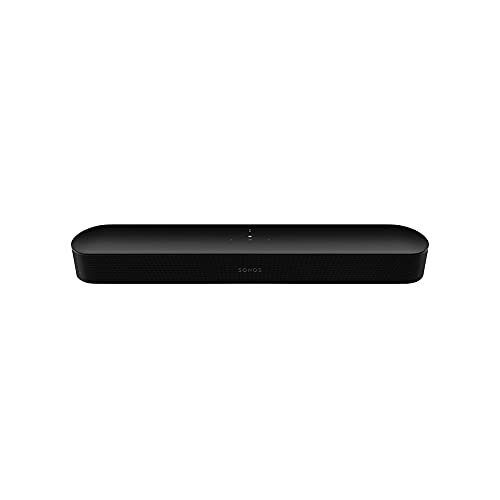
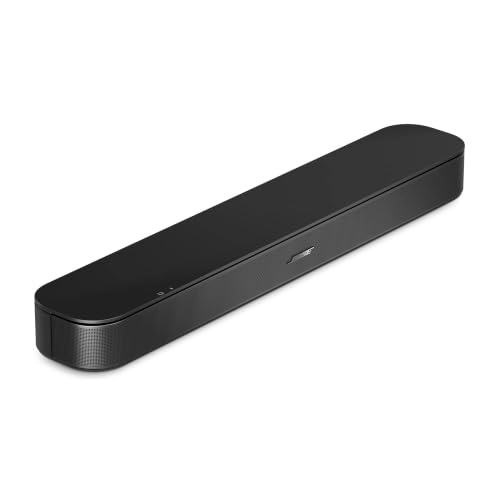
The bars on our list vary a lot in length, according to their makers and the sources in our profiles. The Bose TV Speaker (2nd Gen) is about 23.5 inches wide, the Sonos Beam (Gen 2) is 25.63 inches wide, the Amazon Fire TV Soundbar Plus is about 37 inches wide, and the Polk Signa S4 is 41.2 inches wide. On a 32-inch TV, only the first two are a clean match. On a 55-inch TV, all four fit.
Height matters too. Many TVs have a low stand, and a tall bar can block the bottom of the picture or the TV’s infrared sensor. The Bose bar is 2.244 inches tall and the Sonos Beam is 2.68 inches tall according to their official pages, so both are low-profile. Check the height of your TV’s lower edge above the shelf before you commit.
What Actually Matters in a Bedroom
Night Mode and Dialogue Controls
In a bedroom you usually listen at low volume, and the two features that help most are a night mode and a dialogue boost.
Sonos describes Night Sound as a setting that reduces the intensity of loud sounds and increases the level of quieter ones, and Speech Enhancement as a setting that boosts voice frequencies to clarify dialogue; both are turned on in the Sonos app. Polk’s page says the Signa S4 has a one-button Night Mode that lowers the bass and raises its VoiceAdjust dialogue boost so speech stays audible without increasing the master volume. Bose says the TV Speaker (2nd Gen) has a Dialogue Mode that helps make speech easier to hear.
These controls will not make a movie sound like a theater at 20% volume, but they do the main job: you can follow the plot without waking anyone.
Plug-and-Play Versus Smart Features
Bedroom setups often favor simplicity. The Bose TV Speaker (2nd Gen) comes with an HDMI cable and a remote, supports HDMI ARC and HDMI-CEC so your TV remote can control volume and power, and includes Bluetooth for streaming music from a phone, according to Bose. It has no Wi-Fi or voice assistant, which some people consider a feature.
The Sonos Beam (Gen 2) is the opposite: a smart bar controlled in an app, with Wi-Fi, AirPlay 2 and eARC/ARC support, which makes it handy if you also want to play music in the room. According to the Sonos feature list, it does not have Bluetooth, so check that Wi-Fi and AirPlay suit your phone.
Bass and Your Neighbors
Bass is the sound that leaks. Low frequencies pass through walls and floors much more easily than voices, so a subwoofer is where most apartment noise complaints begin. KEF’s apartment guide recommends setting the sub’s level so that it blends in rather than announcing itself, keeping it out of corners, which make bass boomy and uncontrolled, and away from shared walls, and notes that hardwood floors let bass travel farther than carpet. SVS makes a similar point: a subwoofer at high playback levels produces strong vibrations that travel through floors and walls, so lowering the level reduces both the bleed and the rattle.
That is a good argument for a compact bar with no separate subwoofer in a bedroom or apartment. If you do want more bass, the Polk Signa S4 comes with a wireless subwoofer, which you can place away from the shared wall and keep at a modest level. KEF also notes that movie bass usually comes in short bursts, so films are easier on neighbors than steady, bass-heavy music. The rule here is simply to be considerate and to check your lease or building rules for quiet hours.
Connecting the Bar to a Bedroom TV
Most modern TVs have an HDMI port labeled ARC or eARC. One HDMI cable then carries the sound from the TV to the bar, and with HDMI-CEC your TV remote usually adjusts volume. The Sonos Beam and Bose TV Speaker both come with an HDMI cable, according to their makers, and the Polk Signa S4 box has both an HDMI and an optical cable.
If your TV is older, look for an optical (TOSLINK) output. Sonos includes an optical audio adapter for TVs with an optical output only, and Bose supports optical on the TV Speaker (2nd Gen) but sells the optical cable separately. Bose also lists Bluetooth on that model, which you can use for streaming music but not usually as the primary TV connection.
Dolby Atmos adds one more wrinkle. Sonos marks some Atmos formats as requiring an HDMI eARC connection, and Polk says the Signa S4 requires an HDMI eARC connection between bar and TV for Atmos. Samsung’s soundbar guide adds that the content itself must be mixed in Atmos or DTS:X, so a bar can only deliver Atmos when the show or game you are watching was mixed that way. For a bedroom, that is a bonus, not a reason to buy.
Wall Mounting
A wall-mounted bar saves shelf space and keeps the cables tidy, but each maker handles it differently. Sonos sells a Beam wall mount and the bar has a threaded mounting socket, and Sonos also lists a mount that attaches the Beam to an existing TV mount. Bose sells a soundbar wall bracket separately for the TV Speaker (2nd Gen) and says not to mount it above the TV. Polk’s box for the Signa S4 includes a wall mount template and spacers. The Amazon Fire TV Soundbar Plus has a wall mount kit, according to our profile.
Before drilling, find a stud or use the right anchors for your wall, and check what your lease allows. In a rental, a bar on a shelf below the TV is the lowest-hassle option.
The Models That Fit a Small Room
Sonos Beam (Gen 2)
A compact smart bar with Night Sound and Speech Enhancement. A fit for a bedroom or apartment TV where you also want music over Wi-Fi.
The Beam is 25.63 inches wide, 2.68 inches tall and 3.94 inches deep, according to Sonos, and it connects with the included HDMI cable to your TV’s eARC/ARC port. Night Sound and Speech Enhancement are the two settings most useful for a sleeping household. Sonos also sells wall mount options and a Sub Mini and rear speakers if you ever move to a bigger room. The trade-offs: no Bluetooth on the Sonos feature list, the Atmos height effect is virtual, and setup needs the Sonos app. Our Sonos Beam (Gen 2) profile has the full specs.
Bose TV Speaker (2nd Gen)
The simplest upgrade for muddy TV dialogue: one HDMI cable, a remote and a small footprint. A fit for a bedroom TV where you want no apps or extra boxes.
At about 23.5 inches wide and 4.4 pounds, this is the narrowest bar on our list, which makes it the natural match for a 32 to 43 inch TV. Per Bose, it includes an HDMI cable and a remote, supports HDMI ARC with HDMI-CEC, offers optical for older TVs (cable sold separately) and Bluetooth for music. It has a Dialogue Mode, and Bose’s page does not list HDMI inputs, an aux jack or USB. There is also no separate subwoofer in the lineup, no Wi-Fi and no voice assistant. That is a plus for a quiet bedroom, a minus if you want smart features. Read our Bose TV Speaker (2nd Gen) profile.
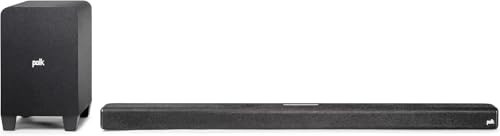
Polk Signa S4
A bar and wireless subwoofer set with VoiceAdjust and Night Mode. A fit for a 50 to 55 inch TV in a bigger bedroom or studio where you want real bass and can control the level.
The Signa S4 is the largest bar in this guide at 41.2 inches wide, so it suits a 50-inch TV (about 44 inches wide) at the very smallest and looks best under a 55-inch screen. The box includes the subwoofer, an HDMI cable, an optical cable and wall mount spacers and template, per Polk. VoiceAdjust and Night Mode are the features that matter after dark. There is no Wi-Fi, only Bluetooth, and the Atmos effect needs HDMI eARC. In an apartment, put the subwoofer away from the shared wall and keep its level down, as KEF advises. See the Polk Signa S4 profile.
Amazon Fire TV Soundbar Plus: A Cautious Mention
The Fire TV Soundbar Plus is a 37-inch bar with built-in subwoofers, and it comes with a wall mount kit, an HDMI cable and a remote, according to our profile. We are not giving it a product box, because the critical coverage is hard to ignore. What Hi-Fi’s coverage called the sound shrill and the dialogue robotic and concluded that most TV speakers would be preferable, though it did like the easy setup and the wide soundstage. The bar’s profile lays out both sides. If you simply want a no-fuss bar with an optional upgrade path, it is a possibility, but try the Beam or Bose first.
Quick Picks for a Small Room
- Tiny TV, simplest setup: Bose TV Speaker (2nd Gen), for its 23.5-inch width and Dialogue Mode.
- Small room, smart features and music: Sonos Beam (Gen 2), for Night Sound, Speech Enhancement and Wi-Fi.
- Bigger bedroom, a 55-inch TV and a sub: Polk Signa S4, with the sub placed carefully.
- Tight neighbors: skip the sub, lean on night mode and dialogue boost, and keep the volume low.
Final Checklist Before You Buy
- Measure the TV and the shelf, and compare the bar’s width and height.
- Check which port your TV has: HDMI ARC or eARC, or optical only.
- Decide whether you want a subwoofer, and where it would go relative to shared walls.
- Decide whether you will mount it, and whether you need a separate bracket.
- Confirm night mode and dialogue controls fit how you watch.
With those five answers, the choice among a handful of small bars gets simple. For more detail on each model, open the profiles linked above, and compare them with the others in our soundbar rankings.
Sources
Frequently asked questions
How wide should a soundbar be for a 32 to 55 inch TV?
A 16:9 TV is about 87% as wide as its diagonal, so a 32-inch set is roughly 28 inches wide, a 43-inch set about 37 inches and a 55-inch set about 48 inches. A bar around the same width as the TV, or a little narrower, looks tidy. For a 32-inch TV, the Bose TV Speaker (2nd Gen) at about 23.5 inches and the Sonos Beam (Gen 2) at 25.63 inches fit; the 41.2-inch Polk Signa S4 is wider than the TV itself.
Do I need a soundbar with a subwoofer in an apartment?
Not necessarily. Bass is the part of the sound that travels through walls and floors, which is why apartment guides, including KEF's, suggest keeping bass levels modest and the subwoofer away from shared walls and corners. A bar without a separate sub, such as the Sonos Beam (Gen 2) or Bose TV Speaker (2nd Gen), is easier to live with when neighbors are close.
What is night mode on a soundbar?
It is a setting that narrows the gap between loud and quiet sounds so you can keep the volume low. Sonos says Night Sound reduces the intensity of loud sounds and increases the level of quieter ones. Polk describes its Night Mode as lowering the bass and raising dialogue so speech stays audible without turning up the master volume.
Can I mount a small soundbar on the wall?
Often yes, but the mount is usually a separate purchase. Sonos sells a wall mount for the Beam (Gen 2) and the bar has a threaded mounting socket, while Bose sells a bracket for the TV Speaker (2nd Gen) and does not recommend mounting it above the TV. Polk includes a wall mount template and spacers for the Signa S4.
Will a soundbar work with a bedroom TV that has only an optical output?
It can. Sonos includes an optical audio adapter for TVs with an optical output only, and Bose supports optical on the TV Speaker (2nd Gen) but sells the optical cable separately. HDMI ARC is simpler because one cable carries the audio and lets the TV remote control volume.
Is the Amazon Fire TV Soundbar Plus a good small-room choice?
It is wide at about 37 inches, and What Hi-Fi's assessment of it was critical, citing shrill sound and robotic dialogue. We keep it as a budget option for people who value easy setup, but we would look at the Sonos Beam (Gen 2) or Bose TV Speaker (2nd Gen) first.